The Massive Opportunity in Cyber Insurance
Cyber Insurance is Growing Fast

Sudip Banerjee
Executive Director and CEO
Audio edition
Listen to this article
Most boardrooms still treat cyber insurance the way they treated fire insurance fifty years ago: a line item, bought once a year, rarely understood beyond the premium amount. That’s changing fast, and the numbers explain why.
Cyber Insurance is Growing Fast
India’s cyber insurance market sat at roughly $752 million in 2025. By 2034, IMARC (opens in new tab) projects it reaching $8.85 billion, growing at a 28.09% CAGR. Other estimates land in a similar range — 752.6 million in 2025 to 6.99 billion by 2034 at 28.10% CAGR, depending on which research house you ask.
The US and global cyber insurance market are larger than India in absolute terms but growing slower percentage-wise. MarketsandMarkets (opens in new tab) pegs the global cybersecurity insurance market at $16.54 billion in 2025, growing to $32.19 billion by 2030 at a 14.2% CAGR, with North America holding a 64.9% revenue share in 2025.
A separate Fortune Business Insights (opens in new tab) estimate puts the broader cyber insurance market at $26.25 billion in 2025, rising to $223.47 billion by 2034 at a 27% CAGR.
Two things stand out.
India is growing from a tiny base — under a billion dollars — at nearly double the US rate.
Cyber is projected to register the highest CAGR of any insurance vertical going forward.
This means big opportunity for anyone who can innovate quickly and effectively in this space.
The biggest problems in cyber insurance
Penetration is low almost everywhere outside North America, but the reasons differ by market.
In India, awareness is the bottleneck more than appetite. Companies of all sizes are only beginning to incorporate cyber insurance into core risk management frameworks, with modular and parametric policies expanding accessibility. The product exists. The buyer education doesn’t.
In the US and other mature markets, the constraint is different: pricing. The absence of standardized terminology is one of the most significant threats restraining industry growth. Without consistent definitions of what counts as a “cyber event,” underwriters can’t price risk consistently, and claims disputes follow.
Underneath both problems is a harder one: insurers are pricing a risk they can’t see. A fire insurer can inspect a building. A cyber insurer is underwriting a network they’ve never looked inside, based on a questionnaire the insured filled out themselves.
Cyber risk has academic frameworks that have been peer-reviewed and presented at venues like the World Risk Insurance Economics Congress, but most carriers still aren’t using anything close to that level of rigor at the point of underwriting.
Claims are the other weak link. When a breach happens, figuring out what was actually compromised, how, and what it cost requires forensic work that most insurers don’t have in-house and most policyholders have never been through before.
Our holistic effort to grow cyber insurance
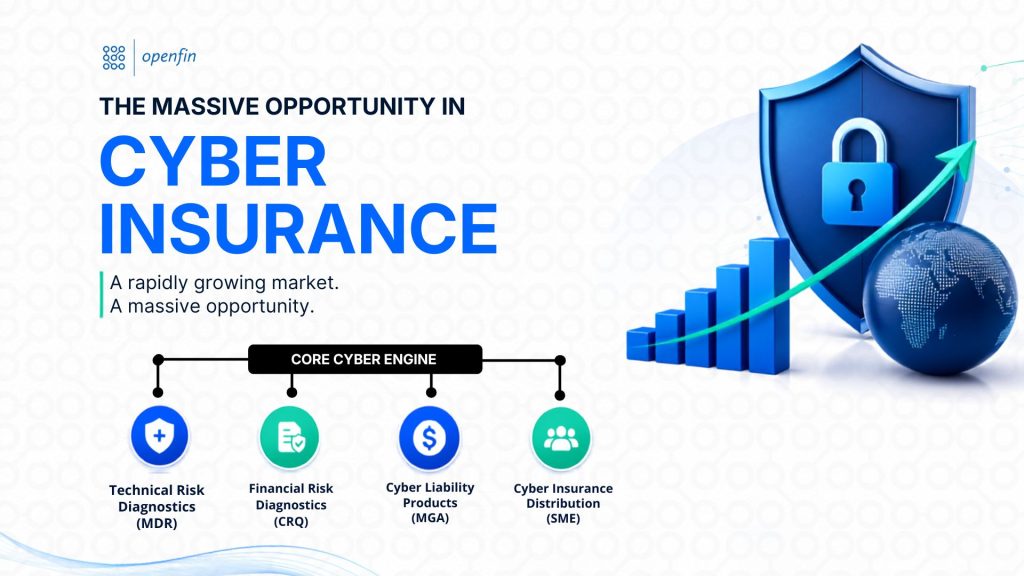
Openfin is building a “Core Cyber Engine” fueled by four connected business units, each addressing a different part of the gap described above.
On one side, we are onboarding ventures focused on Technical Risk Diagnostics, which look at an organization’s actual cyber security posture. This answers the question: What and where are the vulnerabilities?
On the other side, Financial Risk Diagnostics are enabled by our venture Meteoric Cyber (opens in new tab). A Cyber Risk Quantification venture that translates risk posture into the dollar-impact numbers that boards and executives can act on. This answers the question: What is our value at risk due to vulnerabilities and uncertainties?
Meteoric Cyber, based in the US and supported by a global team, has been working on this problem with its partners since 2015. Meteoric helps organizations quantify cyber exposure in financial terms — moving the conversation from a technical one about vulnerabilities to a business one about dollar impact, through their flagship product CRQ Reporting (cyber risk quantification).
The third focus area is underwriting. We are formulating specialized cyber insurance products that can be purchased by SMEs to cover their financial risk in the event of a cyber disaster. This answers the question: How do we survive a cyber breach?
The last focus area is distribution of cyber insurance. We are onboarding ventures, like our company AI Protect Insurance Brokers, to make these specialized SME insurance products available to the market. This answers the question: Where can I purchase cyber coverage?
Our overall goal:
Create a flywheel of efficiency in cyber insurance to address the under-supported growth areas.
Demystify cyber insurance for SMEs
Make it easy to purchase cyber insurance.
Why this matters beyond the numbers
A 28% CAGR sounds abstract until you connect it to what’s driving it: ransomware payouts, regulatory fines under newer data protection laws, and the cost of notifying customers after a breach. These aren’t hypothetical line items anymore for mid-sized businesses in India — they’re showing up on balance sheets.
The opportunity isn’t just selling more cyber policies. It’s building the infrastructure — assessment, quantification, claims forensics — that makes the policies worth buying in the first place. That’s the gap between a $752 million Indian market today and the $7-9 billion one analysts expect within a decade, and it’s where the real value sits.
Are you innovating in cyber insurance? Connect with us to collaborate.
About the Author

Stay updated on insurtech insights
Get our latest research and analysis delivered to your inbox.