Reason, repeat, remember: how we evaluate insurtech ventures
A framework for evaluating insurtech ventures built to last


Kamal Kishore Das and Duncan Platt
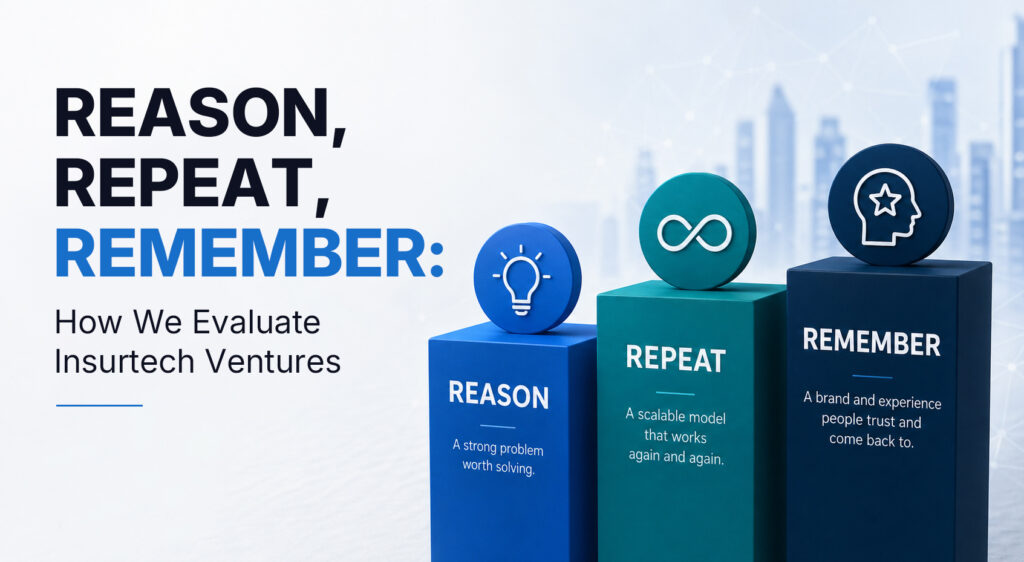
Insurance is a $6+ trillion industry. That number gets thrown around a lot, usually as a prelude to some pitch about disruption. We’re not here to disrupt insurance. We’re here to build ventures that make it work better — and after years of doing this across three continents, we’ve settled on a simple filter for deciding what’s worth building and what isn’t.
We call it the Three Rs: reason, repeat, remember.
These aren’t abstract principles. They map directly to our READ investment thesis (Risk, Embedded, Analytics, Distribution), which frames how we see the $1.1 trillion insurtech opportunity. But READ tells us where to look. The Three Rs tell us what to look for once we get there.
Reason
The insurance industry doesn’t lack data. It lacks new thinking about what to do with it.
Most insurtech pitches we see are automation plays. Take an existing process, make it faster, slap an AI label on it. That’s fine as far as it goes. But the ventures we get excited about are the ones that bring a genuinely different way of reasoning about risk.
What does that look like in practice? A parametric health product that sidesteps the traditional claims adjudication process entirely. A cyber risk model that quantifies exposure for small and mid-sized businesses who’ve been told they’re “too small to insure” by carriers still using frameworks designed for Fortune 500 companies. An underwriting engine that prices flood risk using satellite imagery and hydrological data instead of relying on decades-old flood maps that miss half the actual exposure.
These ventures share a common trait: they didn’t start by asking “how do we make the current process faster?” They asked “what if the current process is solving the wrong problem?”
That distinction matters. Speed without clarity just gets you to the wrong answer quicker. The best underwriting has always been about seeing what others miss — identifying the signal in data that everyone else has access to but nobody else is reading correctly. Technology can help with that. Machine learning can surface patterns in claims data that human actuaries would take years to find. But the technology is the tool, not the thesis. The thesis is the insight. The reasoning.
Within our READ framework, this is where Risk and Analytics live. We build ventures in parametric health, digital risk quantification, and enterprise cyber coverage because these are areas where legacy reasoning has failed. The models are old. The assumptions behind them are older. And the protection gaps they’ve created are measured in billions.
When we evaluate a venture’s reasoning, we’re asking a specific question: does this company see risk in a way that incumbents structurally cannot? If the answer is yes — if the insight is genuine and defensible — then we move to the next question.
Repeat
Can it scale?
This is where most insurtech ventures die. An insight that works in one market, for one line of business, with one regulatory regime, is a consulting engagement. It’s not a venture. The second R is our scalability test.
Scalability in insurance is harder than in most industries. Every market has different regulations. Every line of business has different loss patterns. Every distribution channel has different economics. A flood model that works in Malaysia doesn’t automatically transfer to Indonesia. A micro-insurance product designed for Indian healthcare doesn’t map cleanly onto East African markets. The regulatory environments differ. The cultural relationship to insurance differs. Even the definition of what counts as a “covered event” can shift from one jurisdiction to the next.
So when we say “repeat,” we’re not asking whether a venture can copy-paste its product into a new market. We’re asking whether the principle underneath the product is transferable. Is the underwriting logic portable? Can the distribution model adapt to local infrastructure? Does the technology architecture support multi-market deployment without a full rebuild every time?
This is where our Embedded and Distribution pillars come in. We invest in ventures that weave insurance into existing customer journeys — e-commerce checkout, travel booking, lending platforms — because embedded distribution is inherently repeatable. The integration pattern holds even when the product, the market, and the regulatory wrapper change. We invest in mobile-first, micro-premium distribution models for Southeast Asia, India, and Africa because three billion people still lack adequate insurance. The distribution gap is enormous, and closing it requires models that can scale across culturally distinct markets without losing relevance.
The repeat question is really a question about architecture. Did you build something that can be transplanted, or something that only grows in the soil where it was planted?
Remember
In late 2011, Thailand experienced the worst flooding in at least half a century. Rainfall hit the highest levels in the country’s 61-year precipitation record. Over 30,000 square kilometres went underwater. More than 800 people died. Seven major industrial estates were submerged, disrupting global supply chains for hard drives, automobiles, and electronics. Insured losses reached $15 billion — the costliest freshwater flood in the history of the global insurance industry.
The response from the market was predictable. Reinsurance premiums for Thai exposure spiked from 0.01% of insured sums to 12-15%. Capital fled. Most reinsurers either pulled back entirely or imposed conditions so restrictive that coverage was effectively unavailable. The Thai government had to create a $1.5 billion National Catastrophe Insurance Fund because the private market had repriced itself out of reach.
Then, in November 2025, southern Thailand recorded peak rainfall that exceeded even the 2011 levels — 630mm in 72 hours over Hat Yai, versus 428mm in 2011’s central plains disaster. Different region, different river system. But the same country, the same underlying climate dynamics, and the same lesson: extreme flood events in Thailand are not anomalies. They are features of the system.
This is the pattern that most of the insurance industry fails to hold in view. And it’s the pattern that separates the best operators from everyone else.
Berkshire Hathaway is the clearest example. For decades, Buffett’s reinsurance operation has moved countercyclically — not because it has better models, but because it holds a longer memory. After Katrina in 2005, Buffett warned that the worst was yet to come, even as the rest of the market treated the event as an anomaly and returned to business as usual. When a decade passed without a major US hurricane landfall, premiums dropped and capital poured into catastrophe reinsurance. Everyone forgot. Berkshire pulled out of the super-cat market almost entirely.
After the Thai floods, the same dynamic played out in Asia. Premiums spiked, the market panicked, and then — as the years passed without another major event — rates drifted back down. The memory faded. In 2023, when catastrophe losses had accumulated enough to push pricing back to levels that reflected actual risk, Berkshire made a large bet on property catastrophe reinsurance. By 2024, they were pulling back from Florida’s Citizens program. In 2025, under Greg Abel, they reduced property reinsurance writing again because capital had flooded back in and rates had softened.
The pattern is always the same. A catastrophe hits. Pricing spikes. Capital retreats. Then time passes, memory fades, capital returns, and pricing decays — until the next event that everyone said couldn’t happen again. Berkshire’s edge isn’t better data. It’s the refusal to let recency bias override what the longer record actually shows.
The phrase “once in a lifetime” is itself a kind of memory failure. It implies the clock resets after the event. It doesn’t. The forces that produce extreme floods across Thailand — monsoon variability, La Niña cycles, dam management, expanding urban footprints in floodplains — don’t pause because a major loss just occurred. If anything, several of them are accelerating.
This matters for how we think about building ventures, because memory is something both humans and machines get wrong — just in opposite directions.
Humans misremember. We compress timelines, exaggerate some events, flatten others. A flood that happened 14 years ago feels like ancient history. A few loss-free years feel like proof that the risk has changed. We anchor to recent experience and discount deeper patterns. But we do something that machines can’t easily replicate: we extract principles. We take a messy, partial recollection and distill it into a conviction that guides future action. “Don’t underwrite a risk you don’t understand” is not a data point. It’s a lesson that somebody remembered long enough to learn from.
AI systems have the opposite problem. An LLM can surface the 2000 Hat Yai flood, connect it to the 2011 central plains disaster, cross-reference 2025 rainfall records, and link them to reinsurance pricing trends — all in seconds. The recall is precise. But the machine doesn’t develop the gut-level conviction that an experienced underwriter carries: “this is a market where the risk is chronically mispriced and the next event will be worse than the models suggest.” That conviction comes from principled reasoning applied to memory. It comes from holding the full pattern, not just the most recent data point.
Which brings us back to the first two Rs. Reasoning and repeating are only as good as the memory they’re built on. A venture that reasons well about risk but ignores historical cycles will get blindsided. A venture that scales efficiently but forgets why its model worked in the first place will scale its way into a loss. The three Rs aren’t sequential steps. They’re recursive. Each one depends on the other two.
What this means for how we build
At Openfin, our READ framework tells us where the insurance industry’s structural opportunities sit: in new risk models, in embedded distribution, in AI-powered analytics, and in reaching the billions of people who still lack adequate coverage. The Three Rs tell us how to evaluate whether a specific venture can actually capture those opportunities.
Does it reason differently? Can it repeat? Has it remembered?
When all three hold, you get a venture that isn’t just solving today’s problem. You get one that’s built on principles strong enough to survive the next cycle — whatever that cycle brings.
And in an industry built on the promise that someone will be there when things go wrong, that’s the only kind of venture worth building.
About the Authors

Kamal Kishore Das
Founder and Managing Director
Kamal is founder and CEO of Openfin. He previously held senior positions at ICICI Lombard and founded multiple ventures in analytics and wealthtech.

Duncan Platt
Group CTO and Co-Founder
Duncan is the Group CTO at Openfin. He has over two decades of technical leadership across US and South African ventures.
Stay updated on insurtech insights
Get our latest research and analysis delivered to your inbox.